

Hot Products
AOTUO is a Chinese high-tech enterprise specializing in integrated solutions for dry bulk material port transfer systems, as well as the R&D, manufacturing, and service of high-end dry bulk material port handling equipment.
Contact Us
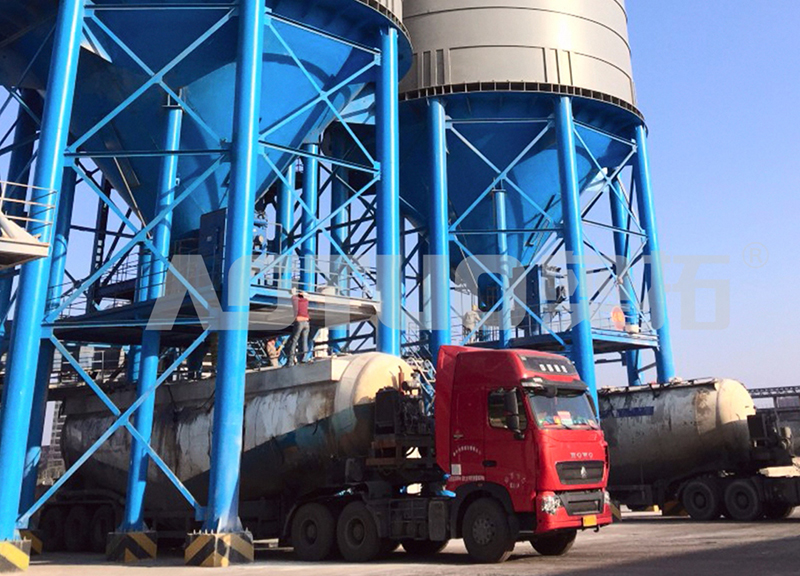
Bulk Truck Loader for Powder/Particle Material Storage - China Suppliers & Factory with High Capacity and Low Energy Consumption
Product Details
The bulk loading machine is mainly used for loading powdery or granular materials at the side or bottom of silos, or in the middle or at the end of conveying equipment. It is primarily categorized into the YXC type for powdery materials at the silo side, the YXD type for powdery materials at the silo bottom, and the clinker bulk loader.
Key Advantages:
- Continuous high efficiency
- High degree of automation
- Minimal dust pollution
- Low energy consumption
Equipment Introduction
YXC Type (Silo Side): Consists of an open aeration chute, aeration connecting chute, aerated screw gate, rotary switch valve, inclined chute, discharge chute, telescopic loading spout, traction mechanism, and pulse dust collector.
YXD Type (Silo Bottom): Features a sealed screw gate, short inclined chute, and integrated material level controller for precise silo-bottom discharging.
Clinker Bulk Loader: Composed of a manual rod gate, electric sector valve, and telescopic spout for heavy-duty material handling.
150-600 tph Bulk Truck Loader
Efficient and Precise Material Handling Solution for Powder/Particle Material Storage.
Product Features
- High-Capacity: 150-600 tph throughput for large-scale transfer.
- Automated: Integrated PLC control systems reduce manual intervention.
- Durable: Reinforced steel and abrasion-resistant components.
Application Areas
- Cement Plants: Transferring powdered cement to trucks.
- Chemical Facilities: Loading granular chemicals.
- Mining: Transferring crushed ore or minerals.
Frequently Asked Questions
1. What types of materials can the 150-600 tph bulk truck loader handle?
The loader is designed for powdered and granular materials, including cement, fly ash, lime, and similar bulk solids. Materials should have consistent flow characteristics.
2. How is the loading rate controlled and adjusted?
The system employs a PLC-based control interface that regulates conveyor speed and chute positioning, allowing operators to adjust the rate based on truck capacity.
3. What maintenance is required to ensure continuous operation?
Regular inspections of conveyors, wear parts, and structural components are recommended. Lubrication schedules and alignment checks will maintain optimal performance.
4. Which industries are these bulk loaders typically used in?
They are widely applied in building materials, electric power, coal, metallurgy, chemical engineering, light industry, grain, and port operations.
5. What is the main difference between YXC and YXD type loaders?
The YXC type is specifically designed for loading materials from the side of a silo, while the YXD type is engineered for discharging materials from the bottom of the silo.
6. How does the system handle dust pollution during loading?
The equipment includes a telescopic loading spout and a pulse dust collector to ensure minimal dust leakage, making the process environmentally friendly.
01
Intelligence

02
High Efficiency
03
Revolution
04
Environmental